
The Unfinished Series – Part 6
The Centrality of Connection
At the center of our existence lies the unshakeable truth: our inherent need for connection. To be human is to live in relation — connection is not a luxury, but one of our highest ethics, woven into the fabric of our being. Even the solitary heart, even the one who longs for silence and solitude, discovers in the cavern of loneliness a restless ache — the longing to be truly seen, to be known, to belong by those they love.
Across the entire spectrum of personality, connection is not optional. It is primal, a necessity for the longevity, vitality, and richness of our existence. Without it, something within us withers. With it, we remember who we are.
And yet, we discard one another too quickly, as if human bonds were disposable — as if people were paper cups to be used and tossed away. This is our tragedy. Aristotle reminds us: “Without friends, no one would choose to live, though he had all other goods.” Yet today, in a world driven by convenience, profit, and speed, genuine human connection is dissolving before our eyes. This erosion is not a small matter; it is an existential crisis that strikes at the very heart of what it means to be human.
The Question of Value
Value. At its root (valere in Latin), it meant strength, worth, vitality — not the materialism and marketplace calculations through which we interpret it now. The word may shift in use, but its root remains. A wooden chair may serve many purposes, but its essence still traces back to the tree. Similarly, a value’s essence lies in its inherent worth, not in its price tag or exchange value.
Over time, however, commerce and trade reduced the value of capital, tied to labor, utility, and exchange. And with that reduction, our moral imagination began to erode. Worth became measured by productivity and output, not dignity. The essence of value was forgotten, and in its place rose a shallow counterfeit.
This distortion seeps deeply into how we treat one another. Relationships themselves are measured like transactions, as though the person in front of us were a profit-and-loss statement to be weighed and discarded. In doing so, we deny the sacred truth: that every human is made in the imago Dei — bearing eternal weight, dignity, and glory. To deny this is not just poor ethics; it is dehumanization at its core.
When Connection Becomes Disposable
To nurture connections that deny the imago Dei is antithetical to flourishing. But neither should we dismiss every challenging relationship as “toxic.” Too often, out of fear of honest introspection, we push away those who challenge us, branding them as unnecessary — when perhaps they are the very mirrors meant to show us our unfinished edges. Growth rarely comes through comfort; it is forged in the fire of trial and testing.
At the same time, we must resist the fast-food ethic of discarding those with whom we disagree — as if they were not flesh and blood, as if they did not carry breath in their lungs, blood in their veins, and hearts that beat like our own. To treat another person as disposable is to forget that we, too, are unfinished — never meant to be industrialized, commodified, or cast aside.
We are not machines to be optimized. We are not products to be packaged. We are not resources to be consumed. We are unfinished people, called to become whole not by rejecting one another, but by learning to bear with one another in love.
History as a Prophetic Marker
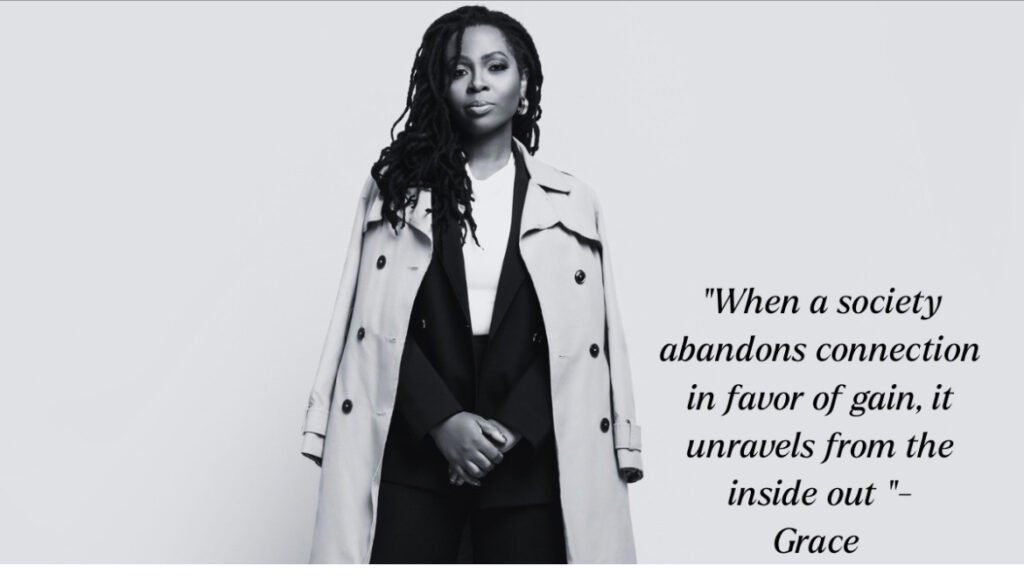
History does not merely repeat — it prophesies. It stands as a witness, warning us before it is too late, if only we will listen. And what does history say? When a society abandons connection in favor of gain, it unravels from the inside out.
In our fast-moving, technologically saturated age, we are setting a new historical record of rejection. We swipe away people like faces on a screen. We unfriend, unfollow, and unsubscribe as though relationships were accessories to our convenience. And if we do not pause to reevaluate our understanding of the human other, we will continue this trade: connection for materialism, presence for productivity, humanity for machinery.
And when we trade connection for materialism, we lose the ability to truly look into another’s eyes — to see the spark of life within them. Without that spark, we lose touch. Without touch, we lose connection. And without connection, we lose ourselves.
As philosopher Emmanuel Levinas reminds us: “The face of the other creates an infinite responsibility; ethics begins in the encounter with another person.” Relationship, then, is not a choice, not a preference, not a contract to be renegotiated. It is a call.
The Call to Renewal
If you find yourself struggling to see another’s humanity — to recognize their inherent value, to honor their sacred worth — it may be that your own heart has grown cold. A cold heart forgets the image it bears. A cold heart forgets its source.
The path back is not through busyness, not through distraction, not through gain. It begins by remembering your own worth — that you, too, were made in the imago Dei.
Return to the God who breathed His Spirit into dust and called it humanity. Return to the One who gave you value before you ever lifted a finger or proved your worth. There begins the journey of renewal — a radical reconnection that awakens your heart to see others as God sees them: unfinished yet invaluable, broken yet beloved, fragile yet chosen.
Selah!